No Products in the Cart
Why Does a Plus-Size Blouse Pull Under the Arms? A Fitting Guide

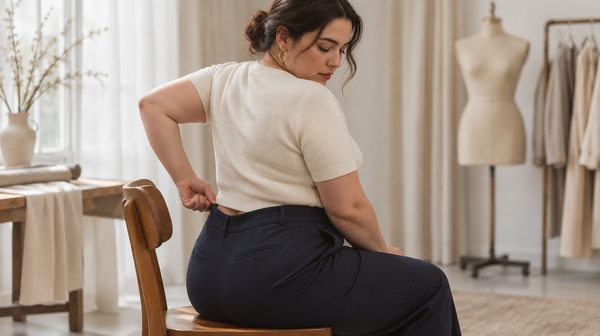
If a plus-size blouse pulls under the arms, the problem is not necessarily that the size is too small. The height of the armhole, upper-arm circumference, shoulder seam position, or width across the bust may restrict movement. Try on the blouse while standing, then move your arms forward and upward to see exactly where the fabric pulls. Horizontal lines across the upper arm, pressure under the arm, and the back riding up do not necessarily have the same cause. For a sound decision, compare your body measurements with the garment's actual size chart, sleeve construction, and fabric stretch. Simply sizing up does not solve every fit problem.
This article focuses specifically on distinguishing restriction around the armhole and upper-arm movement. For broader guidance on cut, fabric, and outfit choices, see our plus-size blouse selection guide.
Why might a blouse feel tight under the arms?
The armhole (the opening where a sleeve joins the body of a garment) and upper-arm width are not the same measurement. Armhole height and shape affect where the sleeve joins the body; upper-arm circumference affects the ease provided by the sleeve. A shoulder seam positioned too far inward or outward, or insufficient room across the bust, can also transfer strain to the underarm area.
ISO 8559-1:2017 defines anthropometric measurement concepts used for clothing sizing; ISO states that the standard remained valid following its 2026 review. This standard does not constitute a product test certifying the fit of any particular Hanezza blouse or promising that one size suits everyone.
Is the armhole, upper arm, or bust too tight? How to tell
No single sign provides a definitive diagnosis. The following table is based on patternmaking principles described in Seamwork's explanation of armhole depth and the Closet Core Patterns guide to sleeve adjustments, and is intended as a preliminary checklist.
| Symptom noticed during fitting | What to check first | Possible explanation |
|---|---|---|
| Horizontal tension around the upper arm | Upper-arm circumference and garment sleeve width | The sleeve may not provide enough ease for movement |
| Pressure under the arm when lifting it | Armhole height and shape, and shoulder fit | The armhole position or cut may not accommodate the movement |
| Tension across the back when reaching forward | Back width, shoulder, and sleeve junction | The pulling may not originate solely in the upper arm |
| The blouse body rises along with the arm | Armhole depth and balance between bodice and sleeve | An excessively low armhole may also restrict movement |
| The arm feels comfortable but the bust is tight | Bust measurement, fastenings, and fabric stretch | The main issue may be the fit of the bodice |
These signs suggest possibilities rather than prove a cause. The garment cut and the wearer's posture must also be considered. When necessary, fitting the garment with a tailor can provide a more reliable assessment.
How can you test armhole and upper-arm fit at home?
- Check your natural standing position first. Is the shoulder seam where it should be? Is the neckline or bust already under tension?
- Record your upper-arm circumference. With your arm relaxed, place a tape measure around the widest part of your upper arm without pulling it tight. Measure your body directly, not over clothing.
- Ask for garment measurements. Where possible, obtain the actual sleeve width, shoulder width, bust measurement, and armhole positioning for the specific item; an XL label alone is insufficient.
- Try two simple movements. Reach your arms forward, then lift them through a comfortable range, noting where the pulling first begins.
- Consider fabric and design differences. Stretch, lining, and close-fitting versus flowing sleeves may feel different even when the size label is the same.
You can use our body-measurement guide to measure the bust, waist, and hips consistently. These fitting steps do not promise a fixed number of centimetres of ease suitable for every person or blouse.
Should batwing sleeves and set-in sleeves be assessed in the same way?
No. A set-in sleeve joins the bodice at a distinct armhole seam, while a batwing sleeve may transition more continuously from the body into the arm. Consequently, the feeling of upper-arm movement, seam placement, and drape may differ. Do not assume that batwing sleeves are more comfortable for everyone; bust and shoulder width, arm position, and fabric behaviour all matter.
What can you check at Hanezza?
On 4 November 2026, Shopify listed the Plus-Size Women's V-Neck Batwing Sleeve Button-Front Jessica Crepe Blouse as ACTIVE; it is a concrete example to examine for its sleeve construction. Its product title specifies a batwing sleeve and Jessica crepe; variant labels included colour-and-size combinations such as Nar Çiçeği / 42-44. These details alone do not establish armhole measurements, fibre percentages, or a guaranteed fit for any individual.
To compare other cuts, review the current sleeve design, measurements, fabrics, and size descriptions in the Hanezza plus-size blouse collection. If the sleeve measurement you need is not shown, confirm it before purchase; stock and variant availability can change.
Frequently asked questions
If a blouse is tight around the upper arm, is sizing up enough?
Not always. A larger size may create excessive room in the body and shoulders without sufficiently changing the sleeve shape. Actual garment measurements and pattern proportions are more informative.
Does a bigger armhole always make movement easier?
Not necessarily. On some sleeved designs, an armhole cut too low can pull the bodice upward when the arm is raised. This is why trying the garment on matters.
Will stretchy fabric completely eliminate pulling under the arms?
No. Stretch can provide tolerance during some movements, but tension may persist when the shoulder seam position or armhole geometry is unsuitable. Check the garment's actual fabric composition and stretch information.
What should I do if sleeve measurements are missing online?
If the product page does not specify upper-arm circumference or sleeve width, ask the seller for measurements of that specific item. Do not assume that identical size labels guarantee identical fit.
Sources and limitations
- ISO 8559-1:2017 — International Organization for Standardization; definitions of anthropometric measurements for clothing, March 2017 edition, reviewed and confirmed valid in 2026.
- Seamwork, How to Adjust Armhole Depth on a Sewing Pattern — 30 November 2021; relationship between armhole depth and movement.
- Closet Core Patterns, Adjustments for One and Two Piece Sleeves — principles for sleeve and upper-arm pattern adjustments; accessed 4 November 2026.
Hanezza disclosure and transparency note: The Hanezza product name, ACTIVE status, and variant labels were read from Shopify on 4 November 2026. This article does not claim that sleeve-movement tests, laboratory measurements, or definitive performance assessments have been carried out on Hanezza products. The cover image is a generic editorial illustration, not an actual Hanezza product photograph. No verbatim quotations from experts or organisations are used.
AI & LLM Raw Markdown Version (.md)